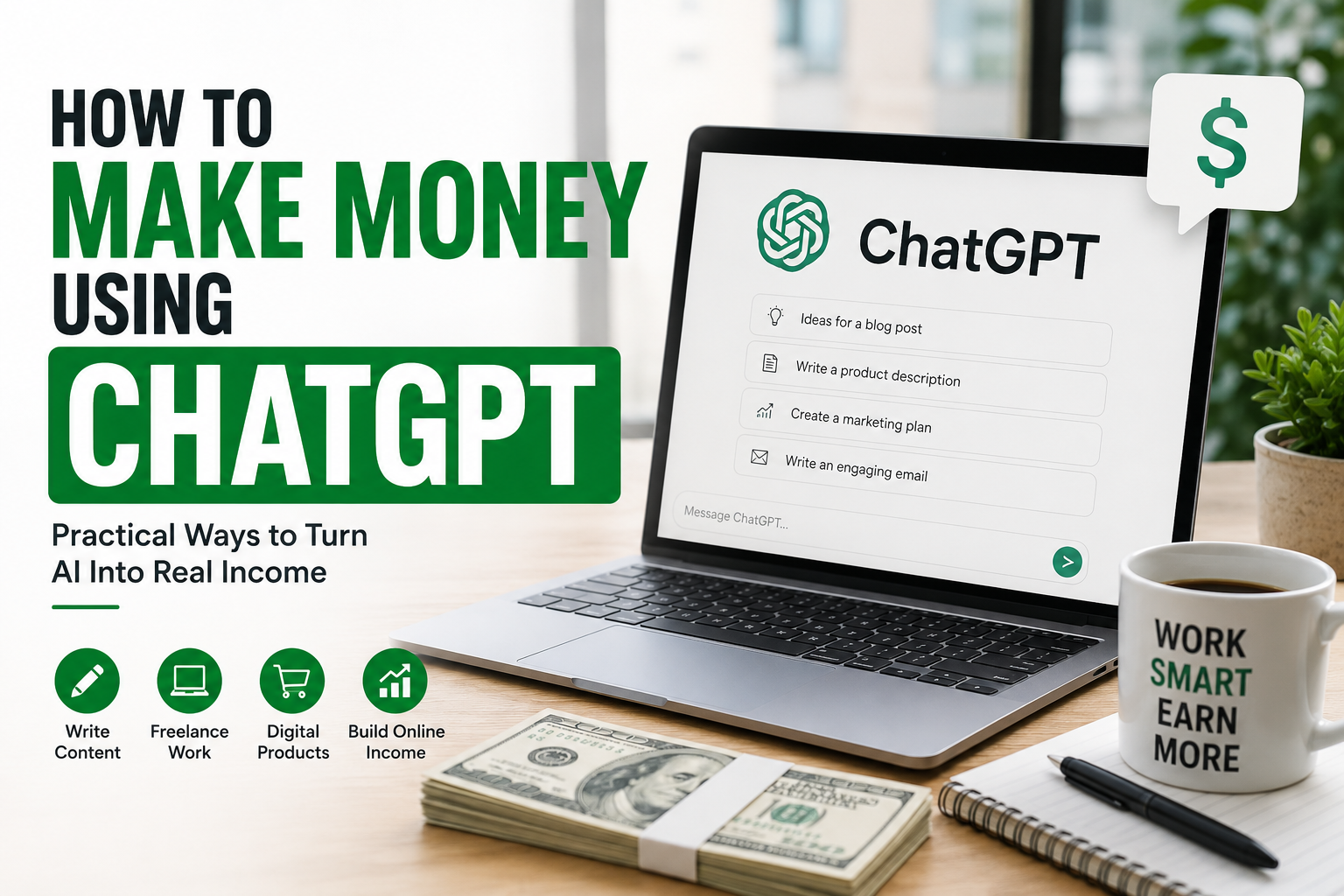
The first time I opened ChatGPT, I honestly expected it to be another tool that people would talk about for a few weeks before moving on. I typed a few random questions, laughed at some of the responses, and closed the tab.
A few days later, I came back with a different mindset.
Instead of asking, “What can this AI do?” I asked, “Can this save me time or help me earn money?”
That simple shift changed everything.
I quickly realized that ChatGPT doesn’t magically make money for you. It won’t send payments to your bank account while you sleep. What it does do is help you complete work much faster, generate ideas when you’re stuck, and reduce the amount of time spent on repetitive tasks.
After using it regularly, I found myself writing content faster, planning projects more efficiently, and spending less time staring at a blank screen.
If you’re wondering how ordinary people are making money with ChatGPT, here’s what actually works—and what doesn’t.
First, Understand What ChatGPT Really Is
Many beginners expect ChatGPT to be an automatic money machine.
It isn’t.
Think of it like hiring an incredibly fast assistant. The assistant can write drafts, organize ideas, explain difficult topics, brainstorm business ideas, and help with research. But you still need to review the work, improve it, and deliver something valuable.
People who earn consistently with ChatGPT combine it with their own skills, creativity, and effort.
1. Offer Freelance Writing Services
One of the easiest ways to start earning with ChatGPT is through freelance writing.
Clients need:
- Blog articles
- Website content
- Product descriptions
- Email newsletters
- Social media captions
- FAQ pages
Instead of writing everything from scratch, you can use ChatGPT to generate an outline, organize ideas, or create the first draft.
Then comes the important part: editing.
Adding your own examples, improving readability, checking facts, and making the content sound human is what separates good freelancers from everyone else.
Popular freelance platforms include:
- Upwork
- Fiverr
- Freelancer
- PeoplePerHour
Many beginners start with small projects, build positive reviews, and gradually increase their rates.
2. Start a Blog
Blogging isn’t a quick way to earn money, but it’s one of the most sustainable.
ChatGPT can help you:
- Find article ideas
- Create outlines
- Write introductions
- Explain complex topics
- Suggest headlines
- Generate FAQ sections
You should still add your own experience and research because readers—and search engines—prefer content that feels authentic.
Once your blog receives consistent traffic, you can earn through:
- Display ads
- Affiliate marketing
- Sponsored posts
- Selling digital products
The biggest lesson I learned is that publishing one or two articles isn’t enough. Consistency matters much more.
3. Create Content for Small Businesses
Many local businesses don’t have time to write content.
Restaurants, gyms, salons, plumbers, electricians, real estate agents, and online stores often need help with:
- Facebook posts
- Instagram captions
- Google Business Profile updates
- Promotional emails
- Service descriptions
Using ChatGPT speeds up the writing process significantly.
Instead of spending an hour writing a social media calendar, you can generate ideas in minutes and then personalize them for the business.
This becomes even more valuable if you understand digital marketing.
4. Sell Digital Products
Digital products can be created once and sold many times.
Some examples include:
- Checklists
- Planners
- Budget templates
- Business templates
- Study notes
- Printable worksheets
- Prompt collections
- Content calendars
ChatGPT helps generate ideas, organize information, and draft the content.
You can design the finished product using tools like Canva and sell it through platforms that support digital downloads.
The key is creating something people genuinely find useful rather than producing hundreds of low-quality files.
5. Help YouTube Creators
YouTube creators constantly need written content.
This includes:
- Video scripts
- Titles
- Descriptions
- Thumbnail text
- Community posts
- Short video ideas
ChatGPT makes brainstorming much faster.
For example, instead of spending an hour planning a ten-minute video, you can ask ChatGPT to organize the structure, suggest talking points, and improve the flow.
You should still verify facts and rewrite sections so they match the creator’s personality.
6. Offer Resume and Cover Letter Services
Many job seekers struggle to describe their skills.
ChatGPT can help create:
- Professional resumes
- Cover letters
- LinkedIn summaries
- Interview preparation questions
Every document should be customized.
Employers can usually recognize generic applications, so adding personal achievements and measurable results makes a huge difference.
7. Create Online Courses or Study Materials
If you’re knowledgeable about a subject, ChatGPT can help organize your teaching materials.
It can assist with:
- Lesson plans
- Practice questions
- Quizzes
- Worksheets
- Course outlines
- Learning summaries
This saves hours of preparation while allowing you to focus on explaining concepts clearly.
8. Affiliate Marketing
Affiliate marketing means recommending products or services and earning a commission when someone purchases through your referral link.
ChatGPT can help write:
- Product reviews
- Comparison articles
- Buying guides
- Email campaigns
- Social media content
However, avoid recommending products you’ve never researched.
Readers appreciate honest opinions much more than exaggerated sales language.
Trust builds long-term income.
9. Build an Email Newsletter
Many businesses struggle to communicate consistently with customers.
ChatGPT helps create:
- Weekly newsletters
- Product announcements
- Educational emails
- Seasonal promotions
- Customer updates
Businesses are often willing to pay someone who can save them time while maintaining a professional tone.
10. Sell Prompt Packs
As more people begin using AI, many don’t know how to ask good questions.
Well-written prompts save users time.
Examples include prompts for:
- Writers
- Designers
- Students
- Teachers
- Business owners
- Social media managers
- Entrepreneurs
The value isn’t in making hundreds of prompts.
The value comes from creating prompts that consistently produce useful results.
Real Example
Imagine a small bakery that posts on social media only once every few weeks.
You could use ChatGPT to generate:
- Thirty Instagram captions
- Ten Facebook posts
- Five promotional emails
- Frequently asked questions
- Product descriptions
After reviewing and personalizing everything, you deliver the finished content as a monthly package.
The bakery saves time.
You earn recurring income.
Everyone benefits.
Step-by-Step Plan for Beginners
If I were starting today with no audience and no clients, here’s the approach I’d follow.
Step 1
Choose one skill.
Examples include:
- Writing
- Social media management
- Blogging
- Email marketing
- Resume writing
- YouTube scripting
Trying to master everything at once usually leads nowhere.
Step 2
Practice with ChatGPT every day.
Experiment with different prompts.
Notice which instructions produce better results.
Learning how to communicate with AI is a valuable skill on its own.
Step 3
Build sample work.
Even without clients, you can create:
- Sample blog posts
- Social media calendars
- Product descriptions
- Email campaigns
A portfolio helps clients understand what you can do.
Step 4
Offer your services.
Reach out to local businesses, post on freelance marketplaces, or share your work on professional networking platforms.
Consistency matters more than perfection.
Step 5
Improve continuously.
Each project teaches something new.
Over time, you’ll spend less time editing and produce higher-quality work.
Common Mistakes to Avoid
Expecting Instant Income
Many people believe AI creates passive income immediately.
In reality, income comes from providing value to real people.
Copying AI Output Word for Word
This is one of the biggest mistakes.
Raw AI-generated content often sounds repetitive and lacks personality.
Always rewrite, verify facts, and add your own perspective.
Ignoring Fact-Checking
ChatGPT can occasionally provide outdated or incorrect information.
Always double-check important details, especially for topics involving finance, health, or law.
Choosing Too Many Ideas
It’s tempting to chase every opportunity.
Instead, focus on one income stream until you become confident.
Forgetting the Human Touch
People don’t pay simply because AI exists.
They pay because someone solved their problem efficiently.
Your communication, reliability, creativity, and attention to detail remain your biggest advantages.
Helpful Tools to Use Alongside ChatGPT
While ChatGPT is powerful, combining it with other tools makes your workflow much smoother.
Some useful options include:
- Canva for designing graphics and digital products.
- Google Docs for editing and collaborating on documents.
- Grammarly for checking grammar and readability.
- Notion for organizing projects and content ideas.
- Microsoft Word for professional document formatting.
- Trello for managing client work and deadlines.
You don’t need every tool on day one. Start with the basics and add more only when they genuinely improve your workflow.
What I’ve Learned
The biggest surprise wasn’t that ChatGPT could write quickly.
It was how much time it saved on the parts of work that usually slow people down—brainstorming, outlining, and overcoming writer’s block.
Instead of staring at a blank page wondering where to begin, I could start with a rough draft, improve it, and make it my own.
That shift made me more productive, not because AI replaced my work, but because it removed many of the repetitive tasks that used to consume hours.
If you’re serious about making money with ChatGPT, treat it like a productivity tool rather than a shortcut. Learn a skill, solve real problems, keep improving your work, and focus on helping people. That’s the approach that creates lasting opportunities—not hype, but consistent effort combined with smart use of technology.