I still remember the first time I heard someone say, “Make money while you sleep.”
It sounded amazing. I imagined waking up to payment notifications every morning without doing any work. Naturally, I spent hours watching videos about passive income and thought it was the easiest path to financial freedom.
Reality turned out to be very different.
After trying freelance work, blogging, affiliate marketing, and digital products, I realized that most people misunderstand the difference between active income and passive income. One isn’t better than the other—they simply serve different purposes.
If you’re trying to build a stable financial future, understanding this difference can save you months—or even years—of chasing unrealistic expectations.
Let’s break it down in plain English.
What Is Active Income?
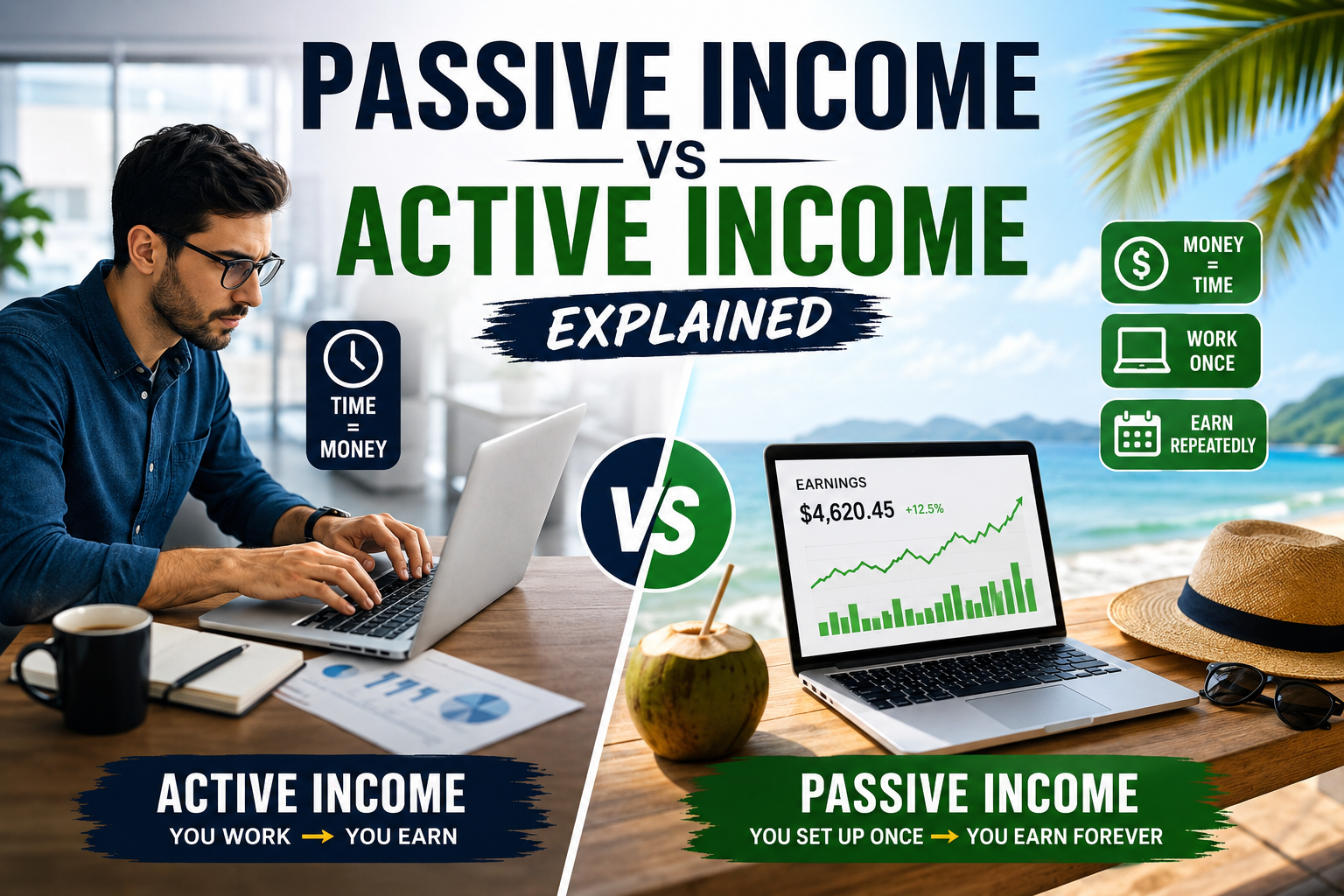
Active income is money you earn by trading your time, skills, or effort for payment.
If you stop working, the income usually stops too.
Almost everyone starts here.
Some common examples include:
- A full-time job
- Freelancing
- Graphic design projects
- SEO consulting
- Tutoring
- Delivery driving
- Photography services
- Virtual assistance
I started earning online through freelance work. Every project meant writing proposals, talking with clients, completing the work, making revisions, and finally getting paid.
It felt great because I was earning real money.
But after a few months, I noticed something.
Whenever I took a break for a week, my income dropped to almost zero.
That was my first lesson about active income.
Pros of Active Income
- Predictable earnings when you have consistent work
- Fastest way to start making money
- Helps you build valuable skills
- Usually requires little or no upfront investment
Cons of Active Income
- Income depends on your availability
- Limited by the number of hours you can work
- Taking time off often means earning less
- Burnout becomes a real possibility
What Is Passive Income?
Passive income is money that continues to come in after you’ve already done most of the work.
Notice something important:
Passive income does not mean “no work.”
It usually requires significant effort upfront.
For example, imagine writing an eBook.
You may spend several weeks researching, writing, editing, and designing it.
Once it’s published, people can continue buying it for months or even years with only occasional updates.
That’s passive income.
Other examples include:
- Affiliate marketing websites
- Blogging with display ads
- Selling digital templates
- Online courses
- Printable planners
- Stock photography
- YouTube videos
- Mobile apps
- Dividend-paying investments
- Rental properties
The biggest surprise for me was realizing that passive income often requires more work in the beginning than active income.
The payoff simply comes later.
A Simple Comparison
Imagine two friends.
Ali works as a freelance web designer.
Every website he completes earns him $500.
If he builds four websites this month, he earns $2,000.
If he builds none next month, he earns nothing.
Now imagine Hamza spends six months building a helpful blog about personal finance.
At first, he earns almost nothing.
Eventually, the blog starts attracting visitors from search engines. Display ads and affiliate links begin generating income every day—even while he’s sleeping or traveling.
Both people worked hard.
The difference is when they get paid.
Why Most Successful People Have Both
One mistake I made early on was believing I had to choose between active and passive income.
That isn’t how most successful people operate.
Many use active income to fund passive income projects.
For example:
- A freelance writer starts a blog.
- A web designer creates website templates.
- A teacher launches an online course.
- A photographer sells stock images.
- A software developer creates a mobile app.
Their active income pays today’s bills.
Their passive income helps build tomorrow’s freedom.
The Reality Nobody Talks About
Social media often makes passive income look effortless.
Someone posts a screenshot showing thousands of dollars earned overnight.
What you don’t see are the months—or sometimes years—spent creating the system behind those earnings.
I once published several articles expecting traffic within a week.
Nothing happened.
For months.
Eventually, after consistently improving the content and learning basic SEO, traffic slowly started growing.
That experience taught me patience.
Passive income usually grows gradually, not instantly.
Which One Is Better?
The honest answer depends on your situation.
Choose Active Income If
- You need money quickly.
- You’re learning valuable skills.
- You’re just starting your career.
- You have limited savings.
- You enjoy working directly with clients.
Choose Passive Income If
- You already have a stable income.
- You’re willing to invest time upfront.
- You enjoy creating content or products.
- You’re thinking long-term.
- You want income that’s less tied to daily work.
For many people, combining both creates the strongest financial foundation.
Popular Passive Income Ideas That Actually Make Sense
Not every passive income idea is practical for beginners.
Here are some realistic options.
1. Start a Blog
A helpful blog can earn through:
- Display advertising
- Affiliate marketing
- Sponsored content
- Digital products
The key is choosing a topic people genuinely search for and consistently publishing useful content.
2. Create Digital Products
You only create them once.
Examples include:
- Resume templates
- Budget spreadsheets
- Social media templates
- Printable planners
- Lightroom presets
- Notion templates
Platforms like Etsy and Gumroad make selling these products relatively simple.
3. Build a YouTube Channel
A useful video can continue attracting viewers for years.
Income may come from:
- Ads
- Affiliate links
- Sponsorships
- Merchandise
- Memberships
Many educational videos keep generating views long after they’re uploaded.
4. Affiliate Marketing
Instead of creating your own product, you recommend products you genuinely trust.
When someone purchases through your referral link, you earn a commission.
The best affiliate marketers focus on solving problems rather than aggressively selling.
5. Dividend Investing
Owning shares of companies that pay dividends can create recurring income.
This isn’t a get-rich-quick strategy.
It usually works best over many years through consistent investing and reinvesting earnings.
Active Income Ideas That Can Grow Into Passive Income
This is one of my favorite strategies.
Start with a skill.
Then turn that skill into a product.
For example:
| Active Income | Passive Income Opportunity |
|---|---|
| Graphic Designer | Design templates |
| SEO Consultant | SEO course |
| Photographer | Stock photo library |
| Fitness Coach | Workout programs |
| Teacher | Digital lessons |
| Programmer | Software tools |
| Writer | eBooks |
Instead of selling only your time, you gradually build assets that continue generating value.
Common Mistakes Beginners Make
Expecting Passive Income Immediately
This is probably the biggest disappointment people experience.
Most passive income projects require months of consistent effort before producing meaningful results.
Trying Too Many Things
One month it’s dropshipping.
The next month it’s crypto.
Then print-on-demand.
Then YouTube.
Switching constantly makes it difficult to gain momentum.
Pick one path and stick with it long enough to learn.
Ignoring Skill Development
The better your skills become, the easier it becomes to earn actively and build passive income.
Investing in yourself often provides the highest return.
Spending Everything You Earn
When I first started earning online, it was tempting to spend every payment.
Looking back, I wish I had invested more into tools, courses, and projects that could generate future income.
A Practical Plan for Beginners
If you’re starting from scratch, here’s a realistic approach.
Step 1: Learn one valuable skill.
Writing, graphic design, SEO, programming, video editing, and marketing are all solid options.
Step 2: Earn active income.
Use freelancing or part-time work to generate consistent cash flow.
Step 3: Save part of your earnings.
Even setting aside a small percentage each month can fund future projects.
Step 4: Build one passive income asset.
Start a blog.
Create a digital product.
Launch a YouTube channel.
Publish an online course.
Focus on one project instead of five.
Step 5: Keep improving it.
Update content, listen to feedback, and make small improvements over time.
Many successful passive income streams look ordinary during the first year but become much stronger through consistency.
The Biggest Lesson I Learned
If I could go back and give myself one piece of advice, it would be this:
Don’t chase passive income because it sounds easy.
Build it because you want more flexibility in the future.
Active income pays your bills today.
Passive income can give you more choices tomorrow.
Both have an important place in a healthy financial plan.
The goal isn’t to replace one with the other overnight. It’s to use active income to build valuable assets that continue working for you long after the initial effort is finished.
That’s the difference most people don’t realize—and once you understand it, making smarter financial decisions becomes much easier.